
Alaska Fish & Wildlife News
November 2026
Encountering Salmon Sharks
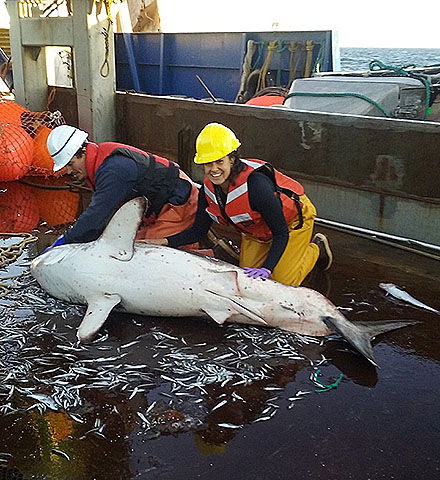
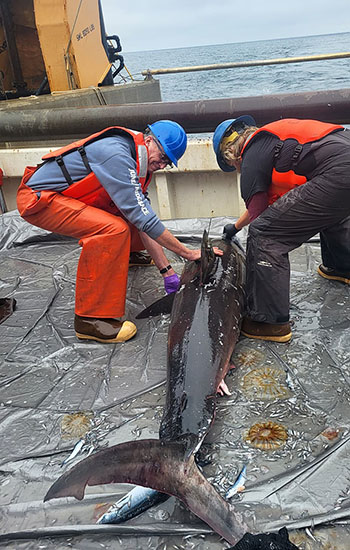
I encountered my first salmon shark 10 years ago. I’m a marine research biologist with ADF&G and was in the Northern Bering Sea doing a juvenile salmon research survey when we incidentally caught the shark in the net. Salmon are the main focus of my research, but over the past decade I’ve helped attach satellite tags to a dozen salmon sharks, working with local and international partners. I also solicit help from the public on salmon shark sightings and encounters to develop a better understanding of their distribution in Alaska waters.
Warm-blooded Sharks
The fact that salmon sharks (Lamna ditropis) are closely related to great white sharks is not the most interesting thing about them. These sharks can be found from the Bering Sea to Baja California. Believed to be the most endothermic of the lamnid sharks, which includes the great white, makos, and porbeagle sharks, salmon sharks can maintain their internal body temperature up to 21°C (70°F) above ambient water temperatures. Given their ability to withstand cold ambient temperatures, salmon sharks may be one of the more northern dwelling sharks in the world and have been caught as far as 67°N – above the Arctic Circle. Like many other sharks, salmon sharks segregate by sex, with females primarily found in the eastern North Pacific and males in the western North Pacific. It is unknown when males and females overlap to mate or whether the sharks found on either side of the Pacific are part of two distinct populations. Satellite tagging sharks, especially males, may help provide some insight into these unknowns.
Shark Tagging
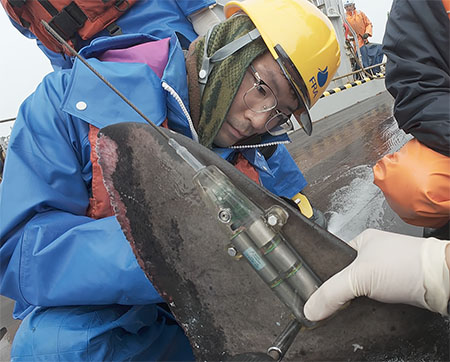
Since 2017, my collaborators and I have opportunistically satellite-tagged 12 salmon sharks. These satellite tags are attached to the shark’s dorsal fin and transmit a location when the shark’s fin is out of the water. These tags work really well with salmon sharks since they tend to spend a lot of time at the surface presumably to encounter prey and to warm up after deep dives in colder water. The tags typically last between 2 – 5 years, but I have had a few tags malfunction after just a few months. While it is frustrating to not get much data back from these tags, especially with how rare it is to catch a shark during a survey, these losses just motivate me to get more tags on sharks! Surpassing all expectations, one of the first sharks we tagged, whose name is Lawrence, has been transmitting locations since he was tagged in September 2019, over seven years ago! During that time, Lawrence made regular migrations between the Bering Sea and the North Pacific Ocean. His last location was received in May 2026, and I will miss checking in on him after all these years.
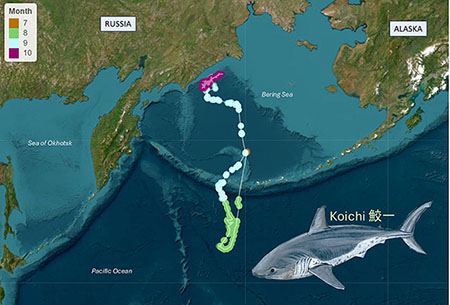
While I would love to tag all the salmon sharks, it usually doesn’t work that way. Since I can’t go out on every single survey that has a chance of encountering a salmon shark, I work with other researchers to provide tags and train them on how to deploy them. This past summer was especially productive, and three sharks were tagged after two years of no sharks being caught during surveys. The first was a male salmon shark tagged by the science crew of the Japanese research vessel Hokko Maru in the central Bering Sea. The next two sharks were tagged by Keegan Birchfield (ADF&G) and the crew of the National Oceanic and Atmospheric Administration (NOAA) vessel, Oscar Dyson, in the southern Bering Sea. It is my tradition that the crew of the vessel get to name the shark, so Koichi, Linkin Shark, and Oscar Tyson have now been officially added to the roster of tagged and tracked sharks. I have four tags that are ready for deployment in summer 2027, so now we just need the sharks to show up!
Shark Reporting
In addition to the tagging work, I also gather information from the public on salmon shark sightings around the state. Citizen science has been extremely helpful through sites like eBird and iNaturalist. While there are salmon shark sightings on iNaturalist, there isn’t an easy way to pull together information on when and where salmon sharks are present around the state that includes state and federal research surveys, catch in sport fisheries, and opportunistic observations from the public. My hope is to pull all these reports together into an interactive map so sightings across time and space are visible to anyone who is interested. It might also make it easier to look for trends across space and time. To date, I have received reports from Southeast Alaska to Point Hope. These interactions with the public allow me to obtain more information like how common salmon shark sightings are in the area and what the sharks were doing when sighted. For example, I have gotten reports about large aggregations of salmon sharks in Kodiak that are there one year and gone the next. It is interesting to think about why these aggregations might be so irregular. In addition to sightings reports, I also get emails asking me how to land a salmon shark or how to cook the meat, but I am not very helpful with those aspects. I appreciate that people take the time to email or call, and I always enjoy talking about these fascinating animals.
Salmon Predators
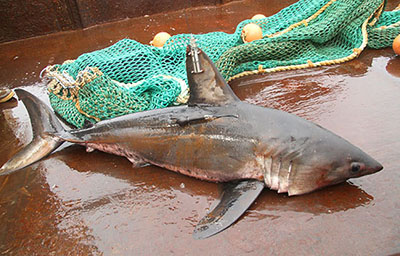
A question I often get asked is, “Why should we care about salmon sharks?” When commercially important stocks of salmon, halibut, and crab are in decline, I can understand why stakeholders want research efforts focused on those species. However, species don’t exist in a vacuum within their ecosystems. As a known predator of salmon, and other commercially important species like rockfish and cod, knowing when and where predators overlap with their prey can provide insight into predation risk and potential hot spots. Additionally, we know that predators can influence prey dynamics, but we don’t know whether salmon shark populations are increasing, decreasing, or stable. While reports from around the state can never replace a dedicated survey, salmon shark observations can provide clues about trends which can help us understand if predation risk is expected to increase or decrease. From an ecological perspective, understanding how these predators move across space and time may also provide information on how species’ might respond to a changing climate. For example, should we expect to see salmon sharks more often farther north as waters warm, and if so, what effect will that have on species there? Given that this salmon shark research happens opportunistically during surveys targeting other species, the knowledge gained is worth the relatively small price of the tag.
Contact
If you incidentally catch a salmon shark please contact me at: 907-267-2180 or sabrina.garcia@alaska.gov. Ideally, please provide the general location caught, date caught, sex (presence of claspers for males near the pelvic fin), and length (tip of snout to fork in tail). Pictures are very helpful, especially of the underside of the shark as we can determine the sex of the shark from pictures (knowing the sex and length is important).
More
To keep tabs on the salmon sharks over the next few years, check out the - The Undersea World of Salmon and Sharks Facebook and Instagram page for updates and more information! Past posts show shark tracks and movements, work in the bersing sea, and more on salmon.
Instagram: @adfg_salmonoceanecology.
Previous articles:
Salmon Shark Tagging in the Bering Sea AFWN 2020
Salmon Shark Sightings AFWN 2023 
Subscribe to be notified about new issues
Receive a monthly notice about new issues and articles.